
No products in the cart.
Bring Premium Value to Your Brand with a Trusted Custom Packaging Manufacturer
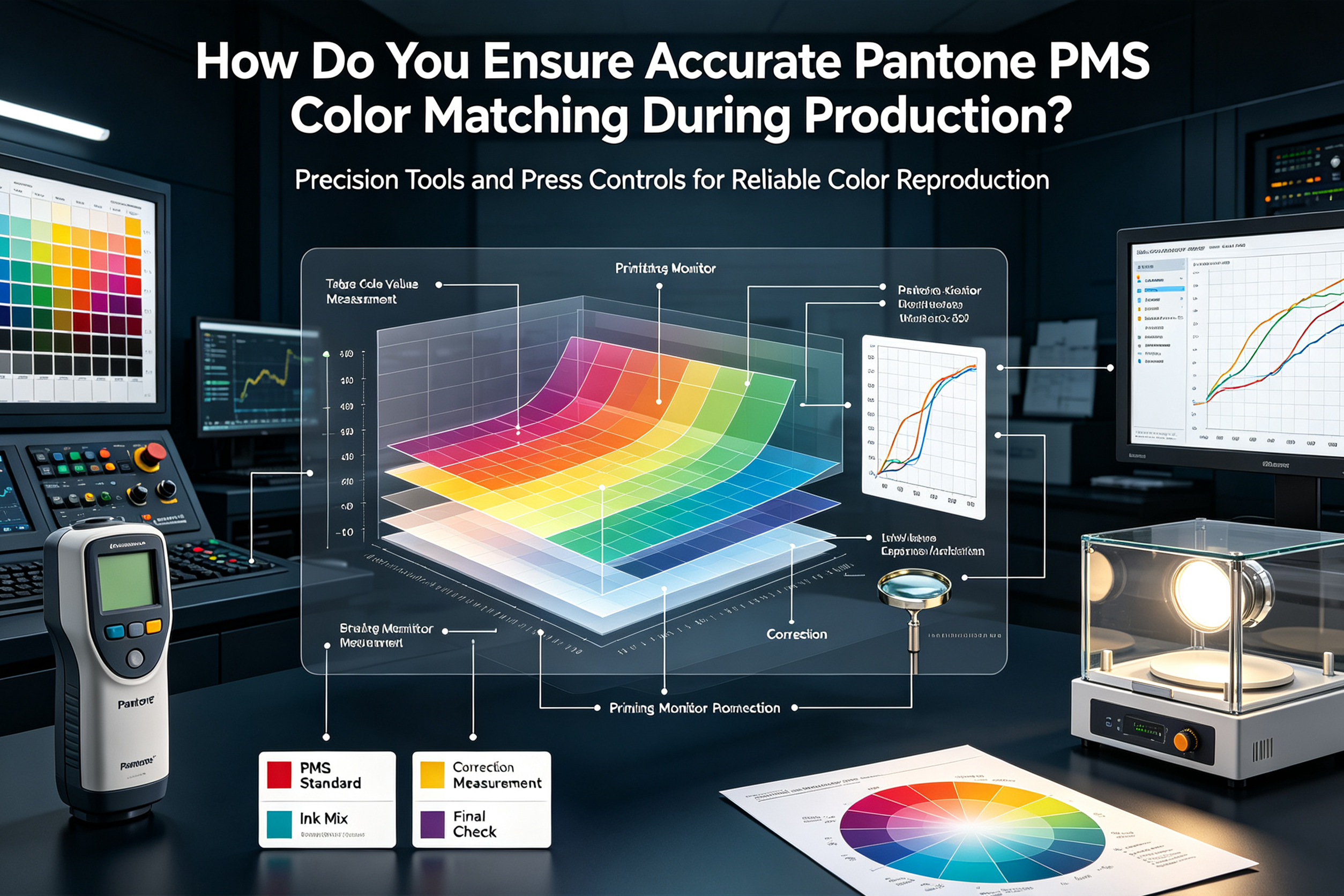
For established retail brands, color consistency is non-negotiable. A subtle shift in your signature brand shade across different retail packaging runs weakens brand identity and lowers shelf appeal.
At Gerun Packaging, we implement rigorous press-room calibration procedures and spectral measurement technologies to ensure every production batch matches your approved master color swatch.
Achieving exact color consistency starts with selecting the proper ink formulation system during prepress design:
CMYK (Four-Color Process): Halftone dots of Cyan, Magenta, Yellow, and Black combine to build full-color photographic imagery. Minor press humidity or ink-key adjustments can cause subtle hue variations across large solids.
Pantone Matching System (PMS): Pre-mixed spot inks formulated using precise weight ratios. PMS spot inks deliver flat, solid, repeatable color coverage across paperboard substrates.
To eliminate subjective human visual bias, packaging quality control relies on objective spectro-photometric analysis:
Delta E (ΔE) Tolerances: Delta E measures the distance between two colors in the CIELAB color space. For custom brand packaging, our press standard maintains a strict ΔE ≤ 2.0 relative to approved physical master proofs.
Substrate Absorption Calibration: Uncoated kraft paper and greyboard absorb ink differently than clay-coated C1S ivory board. PMS inks are custom-formulated based on paperboard absorbency to prevent dulling or color shift.
Computer monitors render colors in emissive RGB light, while paper presses print using reflective CMYK/PMS liquid inks. Color matching must always be verified against physical Pantone PMS color formula guides or physical press proofs.
An offset wet proof (or hard proof) is a physical sample printed directly on the actual production press using your specified paperboard stock and PMS inks. It is the gold standard for verifying color accuracy before commencing mass production.
Yes. Applying Matte lamination slightly reduces color saturation and darkens deep tones, while Gloss lamination enhances color vibrancy. PMS inks are adjusted on press to compensate for your selected surface lamination.
We archive ink formulation recipes, density readings, and physical master retention sheets from your initial production run. Repeat orders are calibrated to these master sheets using spectrophotometers to guarantee batch-to-batch consistency.
Yes. Metallic PMS inks containing fine metallic flakes can be printed via offset lithography to provide a subtle metallic sheen. For intense high-shine metallic mirror effects, hot foil stamping is recommended.
Tel:+86 13723475723
Add:building 10, zone 14th, taoyuanju, xixiang street, Bao'an district, Shenzhen, 518126, China
Connect us by scan whatsApp

CUSTOM PACKAGING SUPPLIER FOR COSMETIC, GIFT, FOOD AND SHIPPING | 2026 COPYRIGHT BY GERUN PACKAGING