
No products in the cart.
Bring Premium Value to Your Brand with a Trusted Custom Packaging Manufacturer
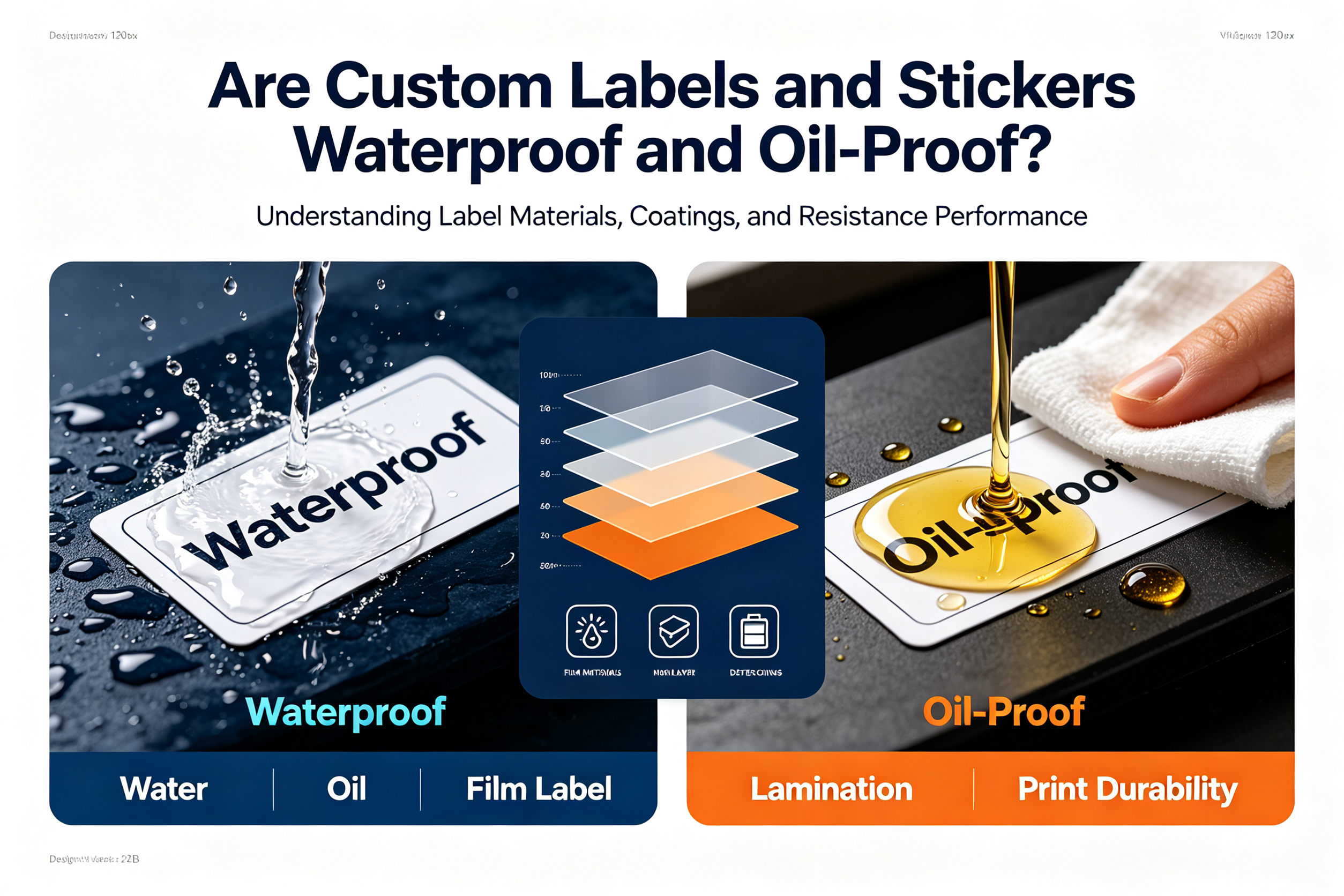
Custom labels and stickers serve as key visual touchpoints across primary containers, secondary boxes, and shipping mailers. For products exposed to moisture, essential oils, condensation, or outdoor handling (such as cosmetics, essential oils, cold beverages, and food jars), standard paper stickers can wrinkle, smudge, or peel.
Selecting the right film substrate, protective lamination, and adhesive grade ensures your custom labels remain securely attached and pristine throughout product use.
Label longevity relies on matching adhesive formulations and protective surface barriers to your container material:
Yes. We supply custom roll labels wound onto standard 25mm, 40mm, or 76mm cardboard cores with precise unwind direction control (Top First, Bottom First, Right First), fully optimized for automatic application lines.
For refrigerated or frozen packaging, we use Freezer-Grade All-Temp Acrylic Adhesives formulated to bond securely in temperatures down to -20°C without crystallizing or lifting.
Roll labels are wound around a central core, making them ideal for high-volume automated application and fast manual peeling. Sheet labels are lay-flat sheets best suited for low-volume hand application or promotional giveaways.
Lifting (flagging) occurs when label stock is too stiff for tight container radiuses. Using flexible 2.3mil BOPP film combined with permanent high-tack acrylic adhesive ensures continuous conformability around small-diameter bottles.
Yes. Industrial rotary label presses apply hot or cold foil stamping, raised tactile varnish, and spot UV embellishments directly onto synthetic roll labels in a single continuous pass.
Tel:+86 13723475723
Add:building 10, zone 14th, taoyuanju, xixiang street, Bao'an district, Shenzhen, 518126, China
Connect us by scan whatsApp

CUSTOM PACKAGING SUPPLIER FOR COSMETIC, GIFT, FOOD AND SHIPPING | 2026 COPYRIGHT BY GERUN PACKAGING