
No products in the cart.
Bring Premium Value to Your Brand with a Trusted Custom Packaging Manufacturer
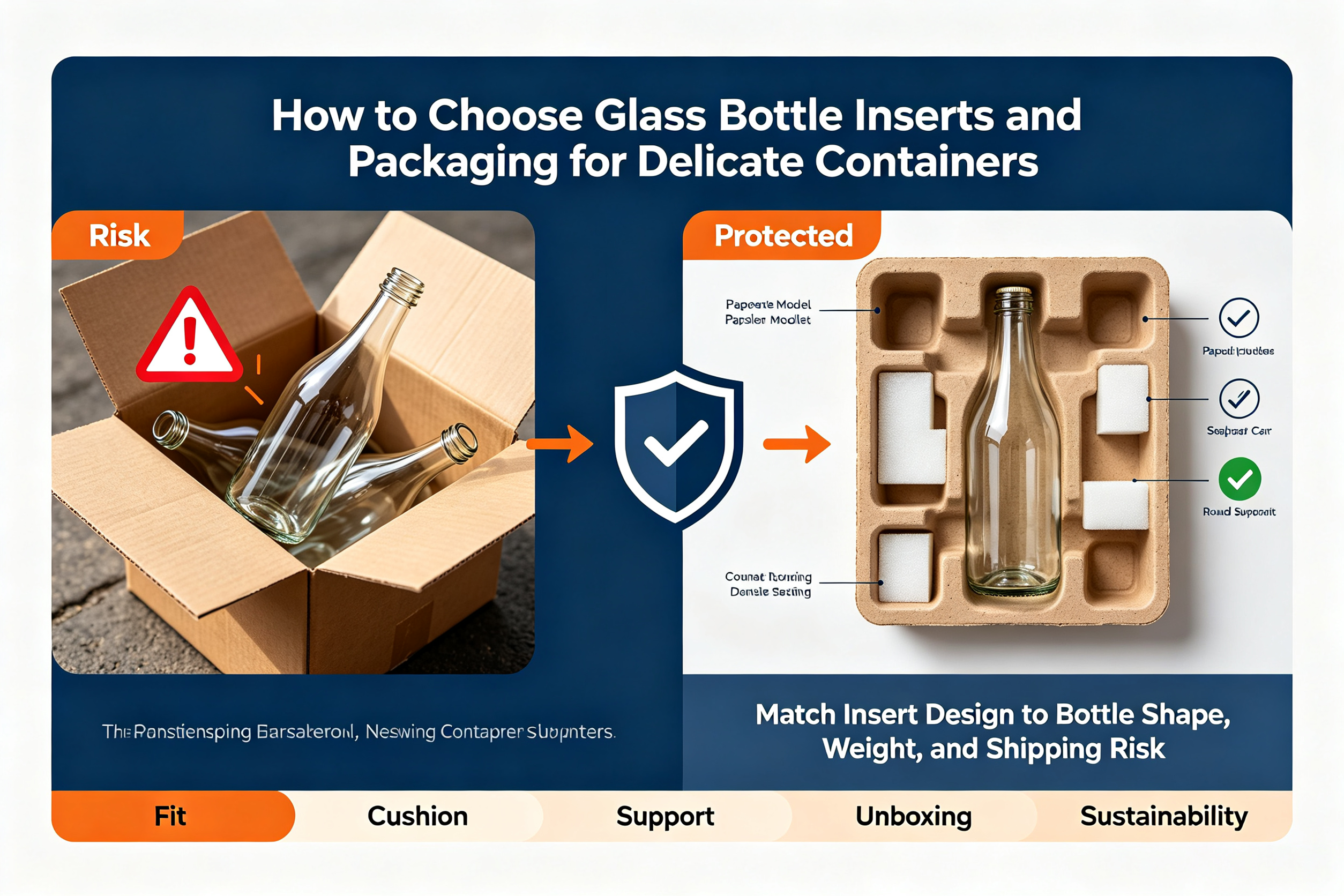
High-end skincare serums, perfume bottles, essential oils, and premium beverages rely heavily on glass containers for visual appeal and product preservation. However, glass is vulnerable to drop impacts, pressure, and transit vibration during parcel shipping.
Preventing transit breakage requires combining a robust outer box shell with precisely engineered internal glass bottle inserts.
[Outer Rigid Box Shell] ➔ [Glass Bottle Inserts / Shock-Absorbing Molded Tray] ➔ [Exact Contour Pocket]
EVA (Ethylene-Vinyl Acetate) foam offers a smooth, rubberized texture with high elasticity and density. EVA glass bottle inserts are laser cut or CNC routed to match exact bottle silhouettes, absorbing heavy drops without compressing or tearing.
Best for: Luxury perfume bottle packaging boxes, skincare serums, and delicate drop-bottles.
EPE foam features a softer, flexible cell structure that delivers excellent shock absorption at a lower material weight.
Best for: Larger glass cosmetic jars, wine bottles, and multi-piece glass kits.
Vacuum-formed clear or black PET plastic trays hold glass bottles securely with snap-lock tabs while maintaining lightweight product profiles.
Best for: High-volume skincare retail cartons and fast assembly lines.
Q1: What is a Velvet-Flocked EVA Foam glass bottle insert?
A velvet-flocked EVA insert consists of high-density EVA foam laminated with a soft velvet textile layer on top. This provides maximum structural shock protection while adding a luxurious, velvety tactile background for glass bottles.
Q2: How much clearance margin should surround a bottle within glass bottle inserts?
A minimum cushion thickness of $8 \text{ mm}$ to $12 \text{ mm}$ of EVA or EPE foam should separate glass bottles from outer box walls to insulate against heavy drop impacts.
Q3: Can eco-friendly, plastic-free glass bottle inserts protect fragile items effectively?
Yes. Custom-molded paper pulp inserts and engineered multi-layer corrugated paper trays provide strong, plastic-free shock absorption and are 100% repulpable in municipal paper recycling streams.
Q4: What drop tests are conducted on boxes with custom glass bottle inserts?
Custom packaging designs undergo ISTA 1A/2A Transit Drop Testing, dropping loaded cartons from heights of 30 inches (76 cm) onto concrete surfaces across 10 distinct orientation angles (corners, edges, faces) to verify protection.
Q5: How do custom insert thumb cutouts improve consumer usability?
Adding semi-circular finger pull cutouts (thumb slots) adjacent to tight bottle pockets allows consumers to lift delicate glass bottles out of rigid foam trays smoothly without pulling on delicate dropper tops or spray caps.
Tel:+86 13723475723
Add:building 10, zone 14th, taoyuanju, xixiang street, Bao'an district, Shenzhen, 518126, China
Connect us by scan whatsApp

CUSTOM PACKAGING SUPPLIER FOR COSMETIC, GIFT, FOOD AND SHIPPING | 2026 COPYRIGHT BY GERUN PACKAGING