
No products in the cart.
Bring Premium Value to Your Brand with a Trusted Custom Packaging Manufacturer
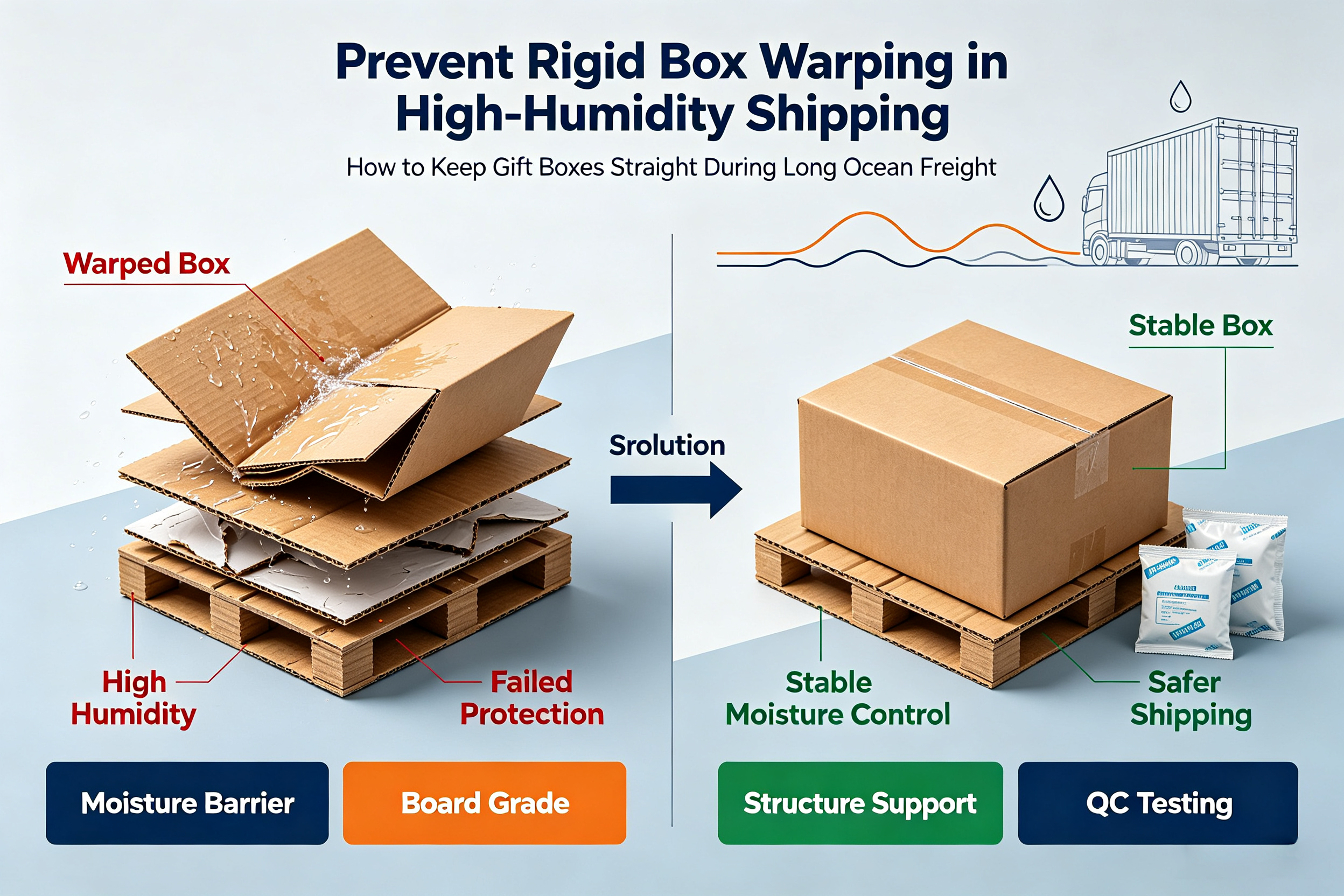
You custom a premium rigid box. It looks flawless in the sample room. You approve it, pay for it, and it goes onto a container ship.
But a month later, when your warehouse in the US or Europe opens that container, you get a nightmare call: the lids are warped. They look bent, they don’t snap shut, and your luxury cosmetics or electronics inside look cheap because the packaging is deformed.
What happened? Most suppliers will blame the “weather” or “marine humidity.” That’s a lazy excuse. The truth is, box warping is 100% preventable if your packaging factory understands paper physics.
The Wood Grain Rule: We never cut paper randomly. Wrapping paper grain and greyboard grain must cross at a 90-degree angle to cancel out pulling forces.
The Glue Trick: We ditch cheap water-based glues. We use animal-based jelly glue with over 50% solid content so less water gets into the fibers.
The Moisture Level: We keep our raw board moisture strictly between 7% and 9%. Anything higher or lower guarantees bending.
The 48-Hour Cure: Every batch sits in a dehumidified curing room for 2 full days before being packed into shipping cartons.
Think of paper and greyboard as a bunch of tiny wood fibers woven together, like a sponge. When the air gets humid (like inside a shipping container crossing the equator where temperatures hit 60°C and humidity passes 90%), these fibers drink up water and expand.
If the paper on the outside expands faster than the thick greyboard on the inside, the paper pushes, the board resists, and the whole box buckles.
Traditional factories just rush the boxes off the machine and throw them into shipping boxes. The moisture gets trapped inside. By the time the ship docks, the damage is done.
Here is exactly how our engineering team at Gerun Packaging stops warping from happening in the first place:
Paper has a “grain direction”—the way the fibers run. If the wrapping paper and the greyboard have their grains running the same way, they pull together and bend the box. We cut our materials so the grain of the outer paper runs perpendicular (at a 90-degree angle) to the inner greyboard. They pull against each other, staying perfectly flat.
Cheap glue is mostly water. When a machine rolls it onto the paper, the paper gets soaked. We use an eco-friendly, animal-based jelly glue. It has a solid content higher than 50%. Less water means less swelling, and it dries much faster, locking the box in its correct shape.
We don’t pack boxes right off the line. Gerun has dedicated curing rooms with heavy-duty dehumidifiers. Every batch of rigid boxes rests here for 48 hours. This lets the glue cure completely and stabilizes the moisture level of the entire box at a safe 8%.
No moisture checks on incoming boards
Strict 7% – 9% moisture cap
Water-based glue (high moisture)
Jelly glue (over 50% solids)
Random cutting to save paper waste
Strict 90° grain cross alignment
Packed immediately into shipping cartons
48-hour climate-controlled curing
If you are tired of crossing your fingers every time your packaging goes on a boat, you need a partner who treats packaging like engineering, not just printing.
Stop losing money on damaged, warped premium boxes. Send a message to Gerun Packaging today. Tell us where you are shipping to, and our team will analyze your box structure and material options for free to make sure it arrives as flat and perfect as the day it was made.
Tel:+86 13723475723
Add:building 10, zone 14th, taoyuanju, xixiang street, Bao'an district, Shenzhen, 518126, China
Connect us by scan whatsApp

CUSTOM PACKAGING SUPPLIER FOR COSMETIC, GIFT, FOOD AND SHIPPING | 2026 COPYRIGHT BY GERUN PACKAGING