
No products in the cart.
Bring Premium Value to Your Brand with a Trusted Custom Packaging Manufacturer
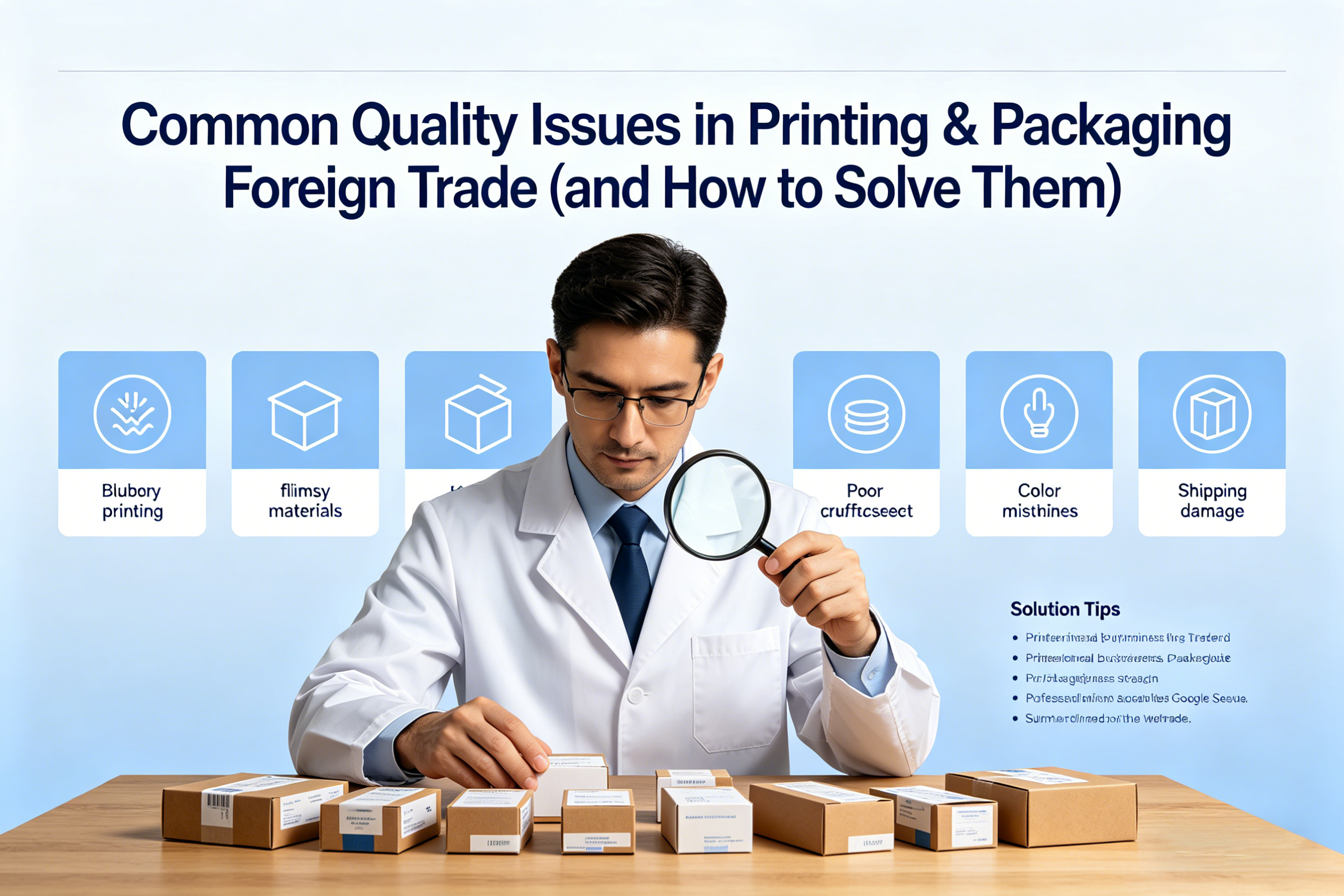
In international supply chains, your custom box is the definitive first touchpoint for your consumer. However, many overseas brands open ocean containers only to discover massive batches of structurally compromised or discolored packaging. Because international reverse logistics costs are entirely prohibitive, spotting technical vulnerabilities during pre-production matters far more than assigning post-shipment blame. Consequently, this engineering-focused guide dissects critical custom packaging quality issues and delivers proven industrial prevention protocols.
Color shifting triggers more commercial disputes in international procurement than almost any other manufacturing flaw. Often, a luxury hue polished on a designer’s calibrated monitor transforms into a muddy, inconsistent tone during volume press runs.
First of all, a fundamental color system conflict drives this issue. Design software operates natively in RGB (light-emitting screen color), whereas commercial printing lines overlay physical CMYK ink matrices. Therefore, if your creative team uploads unconverted RGB source artwork, the pre-press separation software triggers unpredictable color rendering.
Furthermore, substrate absorption properties heavily alter the final visual output. For instance, a specific CMYK ink mix appears sharp and vibrant on uniformly coated ivory board. Instead, that identical ink formula turns dark, flat, and muted when stamped onto highly porous, fibrous natural kraft paper.
For critical corporate logos and expansive flat backgrounds, deploy pre-mixed solid pigments. This process bypasses CMYK screens entirely, holding color deviation thresholds strictly below Delta E < 1.5.
Never accept digital layouts printed on standard office paper as a color sign-off. Consequently, require your factory to execute digital or press proofs directly onto the exact material weight and substrate specified for your bulk order.
Quality control teams must utilize digital spectrophotometers inline during production rather than relying on subjective human eyesight to verify color consistency.
Premium packaging must protect your product throughout harsh transit environments. Weeks spent inside high-temperature, high-humidity ocean containers will rapidly multiply subtle structural weaknesses.
When a folding box travels down an automated filling line or gets handled by a consumer, structural edges can split open. This exposes raw white paper fibers underneath and instantly destroys the luxury aesthetic.
Low workshop humidity dries out the paperboard, or overly sharp matrix steel rules crush the surface fibers during mechanical die-cutting.
Regulate ambient factory humidity strictly before converting. Additionally, for boards exceeding 300gsm, applying an outer matte or glossy lamination film is vital because plastic polymers lock paper fibers in place and entirely eliminate edge cracking.
Boxes look flawless at the factory gate but completely un-stitch or warp after crossing the equator inside a shipping container.
Cheaper water-based adhesives experience rapid thermal degradation when container temperatures spike past 60°C.
For high-stakes export shipments, mandate Polyurethane Reactive (PUR) hot-melt adhesives. PUR glues cure via chemical cross-linking, creating an indestructible bond that resists extreme thermal fluctuations (-40°C to 90°C) and oceanic moisture.
Finishing touches drive retail product margins, yet they require flawless mechanical registration.
Flaking gold foil or blurry text contours occur when hot-stamping machines fail to balance temperature, dwell time, and pressure. If the copper die runs too cool, the thermal adhesive fails to liquefy; if it runs too hot, the foil bleeds past the graphic boundary.
Pre-press engineers must ensure the base offset inks cure fully before foil stamping, while maintaining copper plate temperatures strictly between 110°C and 140°C.
High-gloss coating layers shifting off the underlying printed text create an ugly, amateurish “ghosting” shadow effect.
Eliminating this error requires extreme machine calibration. As a contrast, Gerun Packaging utilizes automated inline silk-screen UV lines operating at a strict mechanical registration tolerance of ±0.15mm. Subsequently, even micro-typography and intricate geometric line art align seamlessly without overlapping shadows.
True, repeatable custom packaging bulk defect prevention relies on clear contractual boundaries rather than luck. International procurement managers must formalize a clear, measurable set of printing packaging foreign trade inspection standards before releasing funds.
Because we map out every vulnerability in global transport logistics, Gerun Packaging deploys a closed-loop quality defense framework within our Shenzhen facility. We refuse to pass defects down the line.
Our engineering division audits all dieline layers, forces text asset outlining, and double-checks bleed parameters immediately upon file receipt to eliminate structural layout slip-ups.
Every inbound paper shipment undergoes strict moisture-content analysis to match the destination climate, while our inks meet international REACH, RoHS, and FDA indirect food contact criteria.
We welcome and seamlessly coordinate with leading global inspection firms (such as SGS, Intertek, and V-Trust) to execute independent mid-production and pre-shipment sampling audits.
If you are searching for an international manufacturing partner that balances strict technical data with transparent B2B communication, Gerun Packaging stands ready to execute your mass production runs flawlessly.
Tel:+86 13723475723
Add:building 10, zone 14th, taoyuanju, xixiang street, Bao'an district, Shenzhen, 518126, China
Connect us by scan whatsApp

CUSTOM PACKAGING SUPPLIER FOR COSMETIC, GIFT, FOOD AND SHIPPING | 2026 COPYRIGHT BY GERUN PACKAGING