
No products in the cart.
Bring Premium Value to Your Brand with a Trusted Custom Packaging Manufacturer
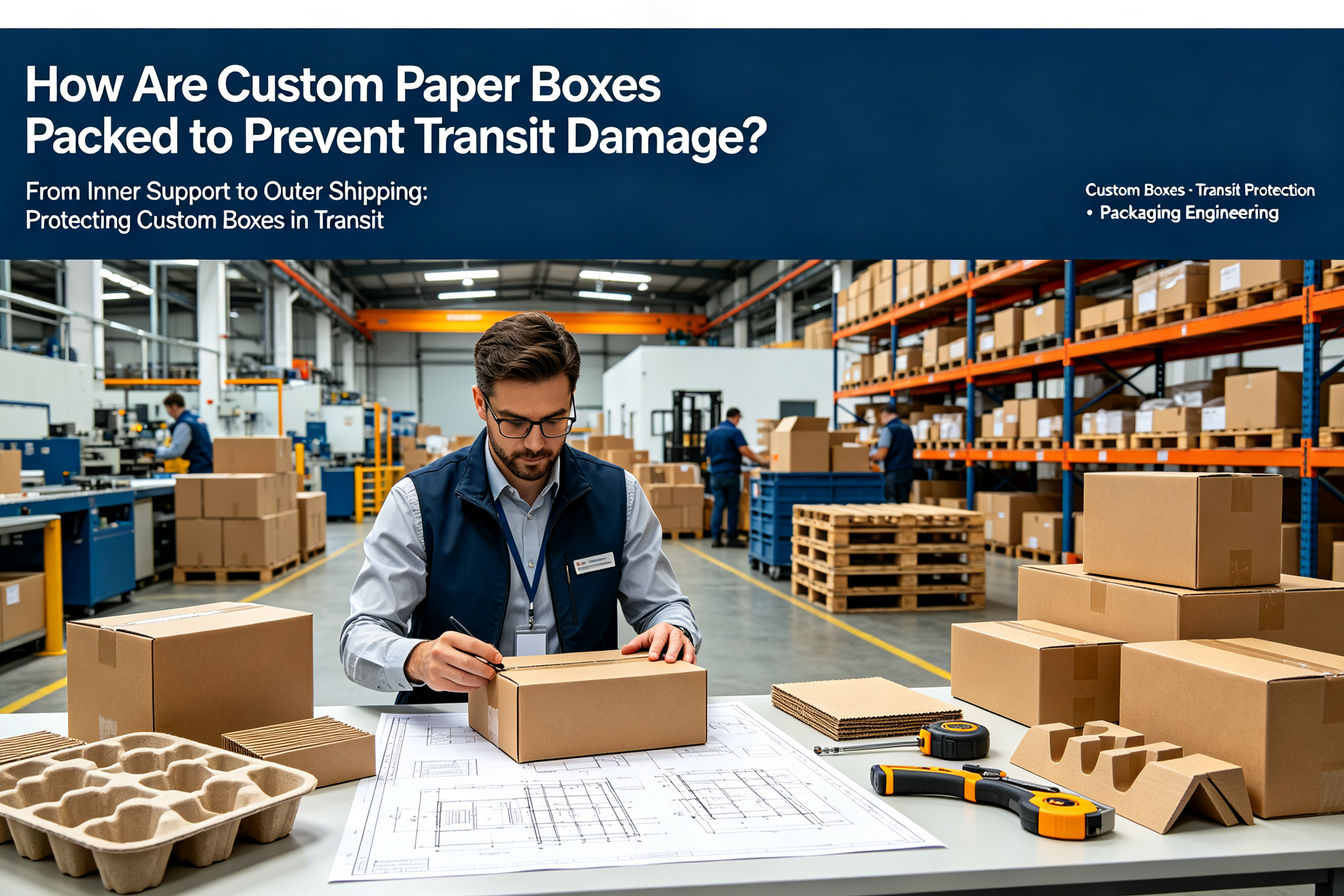
High-quality manufacturing must be matched by robust export packaging standards. Paperboard packaging is susceptible to environmental risks during long-distance ocean transport, including ambient humidity, container condensation (“container rain”), and high stacking pressures.
At Gerun Packaging, we implement strict export packing protocols to ensure your custom boxes, rigid packaging, and paper bags arrive in pristine condition.
Layer 1: Polyethylene Moisture Barrier Bags
Custom boxes are bundled into defined counts (e.g., 25 or 50 units) and sealed inside heavy-gauge polyethylene liner bags before placement into master cartons, protecting against humidity during transit.
Layer 2: 5-Ply Heavy-Duty Corrugated Master Cartons
We utilize export-grade 5-ply double-wall corrugated master cartons (K=K grade) with high Edge Crush Test (ECT) ratings, preventing carton collapse when stacked inside freight containers.
Layer 3: Solid Corner Guards and Strapping
Palletized master cartons are reinforced with heavy-duty V-board paper corner guards along vertical edges to absorb lateral strap pressure and prevent crush points.
Layer 4: Palletizing and Stretch Wrap
Master cartons are stacked uniformly on ISPM-15 certified heat-treated wooden or plastic pallets, fully bound with stretch film to block moisture and prevent carton shifting during transit.
To facilitate safe manual handling at receiving docks, export cartons follow strict dimensional and weight guidelines:
Q1: How do you prevent rigid gift boxes from scuffing against each other inside master cartons?
Delicate rigid boxes featuring soft-touch lamination or hot foil stamping are individually wrapped in tissue paper or packed in protective polybags before being placed into master cartons with interior corrugated divider partitions.
Q2: What is ISPM-15 certification, and why is it required for wood pallets?
ISPM-15 is an international phytosanitary standard requiring solid wood pallets to be heat-treated to eliminate wood-boring pests before international shipping. Compliant pallets bear an official ISPM-15 stamp for global customs clearance.
Q3: How are custom paper bags packed to prevent handle deformation?
Paper bags are packed lay-flat with handles alternating direction per layer, balancing carton depth and preventing handle eyelets or ropes from indenting adjacent bag surfaces.
Q4: How do you prevent moisture damage during equatorial sea freight routes?
In addition to inner polyethylene liner bags, high-capacity desiccant silica gel packs are added to master cartons to absorb ambient humidity during warm sea transit.
Q5: Can master cartons be printed with custom shipping marks and barcoding?
Yes. Outer master cartons are printed with custom shipping marks, including PO numbers, SKU descriptions, gross/net weights, carton counts, and scannable GS1 barcodes for automated warehouse intake.
Tel:+86 13723475723
Add:building 10, zone 14th, taoyuanju, xixiang street, Bao'an district, Shenzhen, 518126, China
Connect us by scan whatsApp

CUSTOM PACKAGING SUPPLIER FOR COSMETIC, GIFT, FOOD AND SHIPPING | 2026 COPYRIGHT BY GERUN PACKAGING