
No products in the cart.
Bring Premium Value to Your Brand with a Trusted Custom Packaging Manufacturer
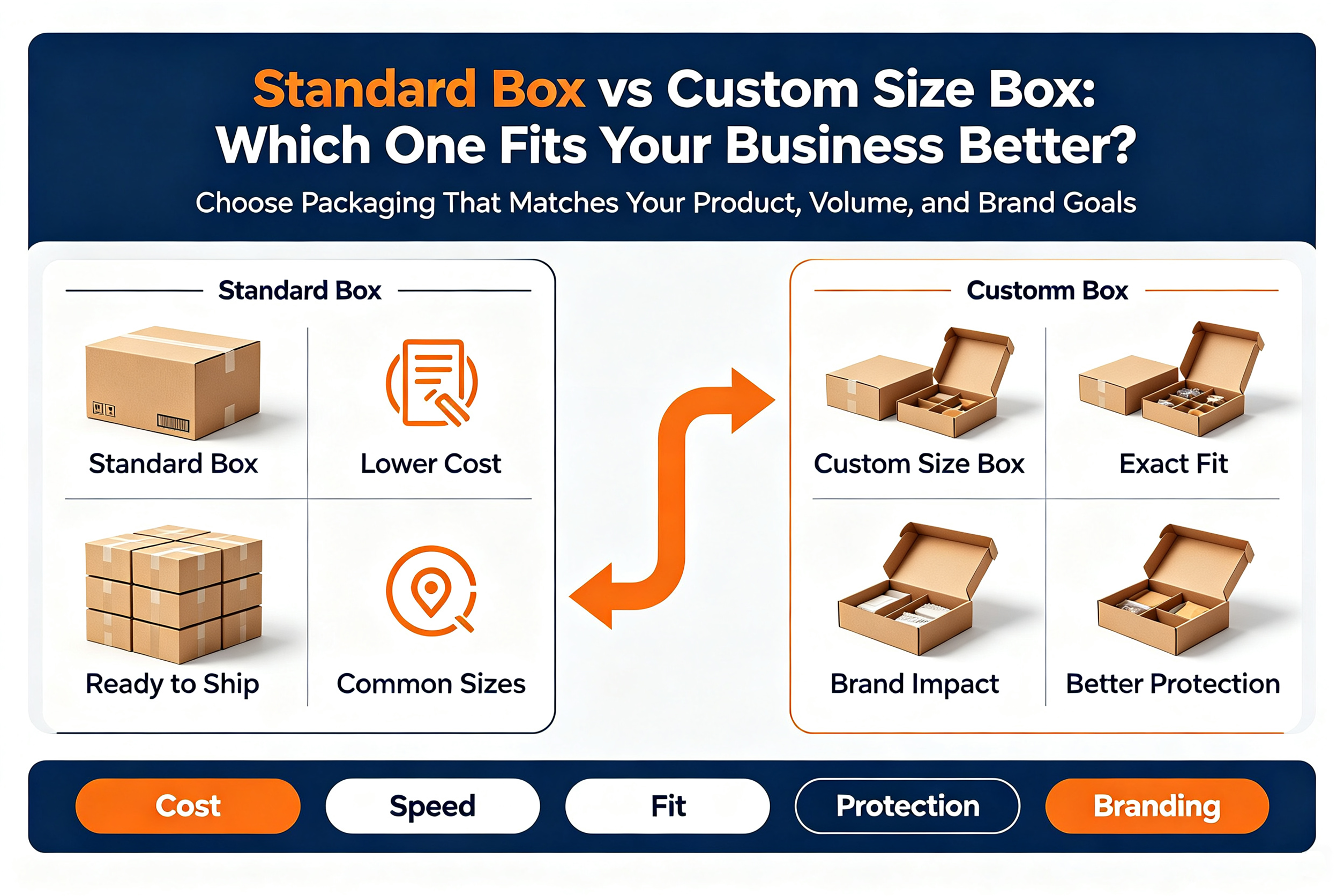
For growing e-commerce and retail brands, selecting the proper packaging dimensions is a primary factor in controlling logistics costs. While stock standard boxes offer quick immediate delivery, they often leave excessive interior void space that requires extra protective void fill and increases dimensional weight charges.
At Gerun Packaging, we manufacture custom size boxes precisely engineered around your physical product dimensions to maximize protection and reduce freight costs.
Courier carriers (FedEx, UPS, DHL) charge based on Dimensional Weight (DIM Weight) calculated from outer carton volume rather than actual physical weight. Investing in custom size boxes tailored closely to your product contours eliminates wasted air space, significantly lowering shipping freight per parcel.
Over-sized standard boxes require extensive secondary packing materials (peanuts, paper fill, bubble wrap). Custom dimensions with exact internal tolerances hold products firmly, preventing shifting during transit while cutting secondary packing waste.
Q1: What is Dimensional (DIM) Weight, and how do custom size boxes reduce it?
DIM weight is calculated as $(L \times W \times H) / 5000$ (or $139$ for US domestic). Decreasing box length, width, and height by just $2 \text{ cm}$ each reduces total cubic volume exponentially, dropping parcel shipping costs.
Q2: What is the initial minimum order quantity (MOQ) for custom size boxes at Gerun Packaging?
Our structural packaging MOQs start at 500 units for custom folding paperboard cartons and corrugated mailer boxes, making custom dimensions accessible for scaling DTC brands.
Q3: Can a custom size box be designed to hold multiple distinct SKUs simultaneously?
Yes. We engineer modular custom insert trays (foam, paperboard, or molded pulp) that fit inside a single standardized outer box, allowing one exterior custom box size to hold multiple product configurations securely.
Q4: How much tolerance buffer should be added when measuring a product for custom size boxes?
Typically, a clearance margin of $1.5 \text{ mm}$ to $3 \text{ mm}$ is added beyond the exact physical dimensions of your product to ensure smooth insertion and extraction without tight friction jamming.
Q5: Is a one-time die mold fee charged on repeat orders of custom size boxes?
No. Steel rule die molds and magnetic foil blocks engineered for your custom box dimensions are stored in our physical die library for up to two years. Tooling setup fees are waived on repeat re-orders.
Tel:+86 13723475723
Add:building 10, zone 14th, taoyuanju, xixiang street, Bao'an district, Shenzhen, 518126, China
Connect us by scan whatsApp

CUSTOM PACKAGING SUPPLIER FOR COSMETIC, GIFT, FOOD AND SHIPPING | 2026 COPYRIGHT BY GERUN PACKAGING